The dream of building a career in the Indian Administrative Service (IAS), Indian Police Service (IPS), or Indian Foreign Service (IFS) is woven into the ambitions of millions, but realised by only a determined few who combine strategy, consistency, and resilience.
Throughout the UPSC journey, there are days when mock test scores often dip, current affairs seem to be endless, and the number of topics looks difficult to cover. Yet, what separates the successful candidates from the rest isn't the absence of struggles, but their ability to overcome them with the correct preparation strategy.
The ones who make it through this prestigious exam are those who are pretty much clear with the syllabus, marks distribution, and the distinct demands of each stage of the examination. Whether you are a beginner or have made previous attempts, this informational segment will be the guide that will definitely ease your preparation strategy.
Understanding the Structure of the UPSC CSE
UPSC Civil Services Examination (CSE) is a three-stage process designed to test a candidate's knowledge, analytical ability, ethical grounding, and administrative aptitude. Conducted by the Union Public Service Commission, the exam consists of three phases:
- Preliminary Examination (Prelims)
- Main Examination (Mains)
- Personality Test (Interview)
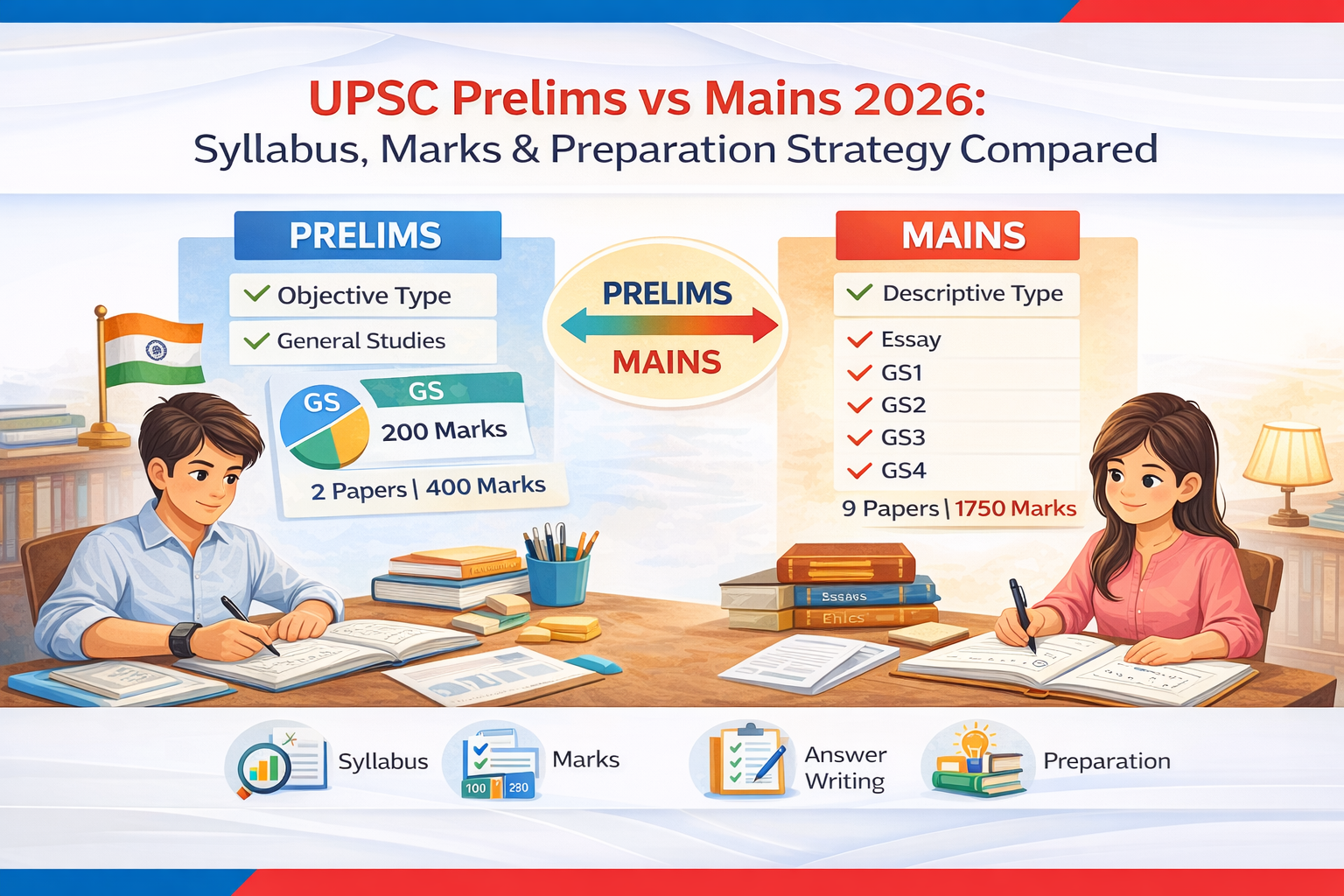
Prelims is objective in nature, fact-oriented, and elimination-based, which filters serious contenders from the massive applicant pool. If lakhs of students sat for the Prelims, only around 10-15 thousand candidates (approximately) qualify for the mains stage. On the other hand, Mains is descriptive, analytical, and depth-oriented, which decides the ranks of the individual in the final merit list.
UPSC Prelims 2026: The First Stage To Cross
Prelims may seem "just a qualifying exam", but it is a screening test designed to filter candidates for the Mains. You need to be well-prepared to sail through this stage.
The UPSC Prelims has two papers, each lasting two hours:
- General Studies Paper I (GS I)
- Civil Services Aptitude Test (CSAT/GS II)
| Paper | Duration | Marks | Nature |
|---|---|---|---|
| GS I | 2 hrs | 200 | Ranking |
| CSAT I | 2 hrs | 200 | Qualifying |
CSAT paper must be passed with atleast 33% (66/200 marks). Along with this, there is a negative marking of 1/3rd of the marks for incorrect answers.
UPSC Prelims 2026 Syllabus Overview
The Prelims syllabus is broad yet factual, requiring recall of diverse topics:
- History: Indian history (ancient, medieval, modern), and a small section of world history
- Geography: Physical, human, and economic geography of India and the world
- Polity: Indian Constitution, Judiciary, Parliament, State Legislatures and more
- Economy: Banking system, economic survey highlights, government schemes, and monetary policy
- Environment & Ecology: National parks, wildlife sanctuaries, sustainable development
- Science & Technology: Awareness of recent developments
- Current Affairs: The backbone of the Prelims
Tips To Qualify Prelims 2026
- Begin with NCERTs: Build strong fundamentals through NCERT books for UPSC (Class 6-12)
- Limit Your Resources: Stick to standard books and revise them frequently
- Be attentive with Current Affairs: Read at least 9 months of current affairs
- Solve Previous Year Questions (PYQs): Go through PYQs to understand exam trends
- Practice Mock Tests: Attempt regular full-length mocks
- Learn Elimination Technique: Master the art of eliminating wrong options logically
- Don't be lenient with CSAT prep: Practice comprehension, data interpretation, and basic reasoning
UPSC Mains 2026 Syllabus Overview
UPSC Mains is a descriptive examination that tests your depth of knowledge, analytical skills, and writing abilities. Marks obtained in Mains directly influence your final ranking.
UPSC Mains Exam Pattern & Marks
| Qualifying Papers | Marks | Merit-based Papers | Marks |
|---|---|---|---|
| Paper A–Indian Language | 300 | Essay | 250 |
| Paper B–English | 300 | GS I | 250 |
| GS II | 250 | ||
| GS III | 250 | ||
| GS IV (Ethics, Integrity, & Aptitude) | 250 | ||
| Optional Paper I | 250 | ||
| Optional Paper II | 250 |
UPSC Mains Papers Layout
- Paper A–Indian Language: Choose one Indian language listed in the 8th Schedule of the Constitution
- Paper B–English: Common English paper to test comprehension skills, precis writing, and grammar
- Essay Paper: Write two essays from a given list of topics
- GS Paper I: Indian Heritage & Culture, History of India, World History, Geography
- GS Paper II: Governance, Constitution & Polity, Social Justice, International Relations
- GS Paper III: Economy, Agriculture, Science & Technology, Environment, Internal Security
- GS Paper IV: Ethics paper with case studies, integrity & aptitude, emotional intelligence
- Optional Subject Papers: Choose one optional subject, consisting of two papers, 500 marks total
Tips to Qualify UPSC Mains 2026
- Answer-Writing Practice: Write at least 2-3 answers per day with headings, subheadings, diagrams
- Integrate Current Affairs: Support answers with recent examples, government schemes, and reports
- Optional Mastery: The optional subject carries 500 marks—choose wisely
- Revision: Create crisp notes, use flowcharts and mind maps for quick recall
Preparation Strategy: Combining Prelims & Mains
Overlap Subjects: History, Geography, Polity, Economy, Environment, and Current Affairs appear in both exams.
Phased Study Plan:
- Phase 1 (6–8 months): Focus on Prelims; NCERTs, static portions, current affairs, mock tests
- Phase 2 (4–6 months): Focus on Mains; answer writing, optional subjects, essay, and ethics practice
Common Mistakes to Avoid in UPSC 2026
- Ignoring CSAT due to overconfidence
- Over-reliance on coaching material; lacking personal notes
- Neglecting answer writing practice for Mains
- Skipping ethics & case studies in GS IV
- Not integrating current affairs with static subjects
- Leaving the optional subject preparation late
FAQs
Q1. Can I prepare for Prelims and Mains simultaneously?
Yes. Focusing on overlapping subjects like History, Geography, Polity, Economy, and Current Affairs saves time and effort.
Q2. Is CSAT difficult?
No, CSAT is qualifying. With basic practice in comprehension, reasoning, and numeracy, aspirants can clear it comfortably.
Q3. How important is answer writing for Mains?
Crucial. Regular practice improves structure, clarity, and speed, boosting overall Mains score significantly.
Q4. How many months are enough for Prelims 2026?
Typically, 8–12 months of structured preparation with revision and mocks is ideal.
Q5. Best sources for current affairs?
Newspapers (The Hindu, Indian Express), PIB releases, government reports, and magazines like Yojana or Kurukshetra.